

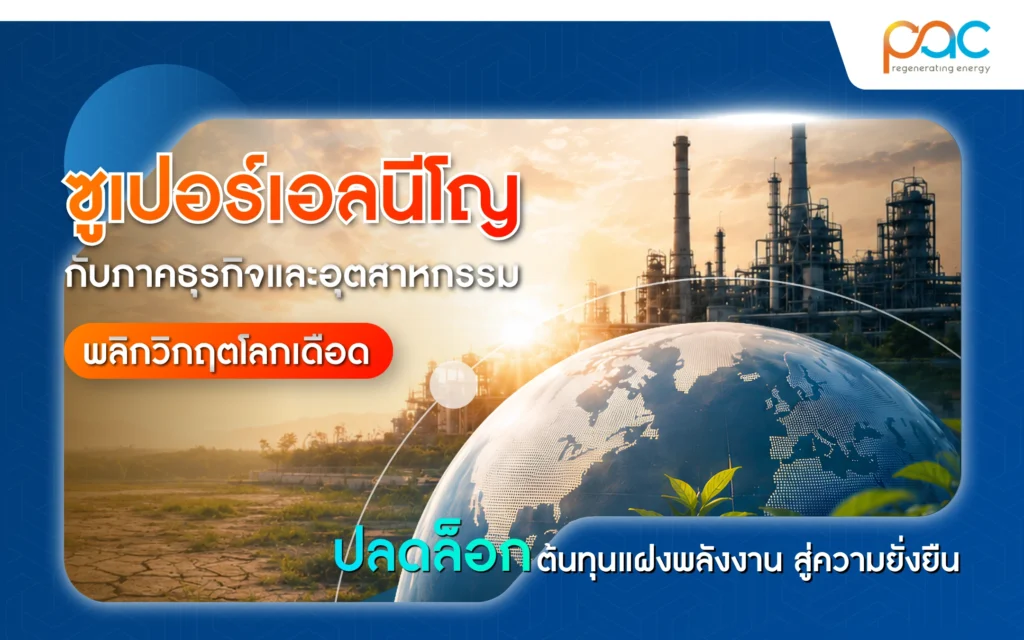
When "Super El Niño" Becomes a Turning Point for Energy Costs
The National Oceanic and Atmospheric Administration (NOAA) has officially announced that “El Niño” conditions have formed in the Pacific Ocean. Notably, there is a 63% chance that it will develop into a “Super El Niño,” which is exceptionally severe.
This phenomenon has led scientists to predict that 2026 could be the hottest year on record. For the business and industrial sectors, this is not just a daily weather forecast, but an “emergency alert for energy costs.” As heatwaves become more intense and abnormally prolonged, every degree of temperature increase means internal engineering systems must work exponentially harder.
When outdoor temperatures exceed limits, air conditioning and cooling systems must draw significantly more electricity to remove heat from the space. “This is the first stage of waste that every business must face.” Furthermore, businesses that regularly use hot water may face a heavy financial burden to produce water at the required temperature. “It is as if we are carrying a squared energy burden.”
Looking deeper into the root cause, allowing cooling and heating systems to operate completely independently in extreme heat creates “Double Loss,” which becomes a massive hidden cost eroding corporate profits amidst the Super El Niño conditions the world is about to face.
The Impact of “Super El Niño” on the Industrial and Business Sectors
- Manufacturing: In heavy-duty production lines where machinery already generates high heat, extreme outdoor temperatures put cooling systems at risk of overloading. Meanwhile, production processes still require a continuous supply of high-temperature hot water. If factories continue to use traditional electric water heaters, the business may face enormous energy costs.
- Healthcare: Hospitals must strictly control temperatures in sterile areas, and extreme heat forces compressors to work 24/7. Additionally, hot water is indispensable for maintaining hygiene. Relying on traditional electric water heating systems will further drive up central energy budgets to unpredictable levels.
- Hospitality: It is common for guests to use air conditioning constantly, causing compressors to exhaust massive amounts of waste heat. Simultaneously, hotels must pay huge electricity bills to produce hot water for guest rooms, resulting in an unconscious waste of energy costs.
It’s Time to Change—Not Just for “Us,” but for the “Planet”
It is evident that the arrival of “Super El Niño” does not only impact the massive energy costs eroding business profits; allowing global temperatures to continue rising will inevitably create a crisis for all life and the environment we inhabit in the long term.
Amidst the intensifying heat crisis, transitioning to a sustainable business (ESG) is the solution that addresses both reducing “hidden costs” and protecting the planet simultaneously. PAC innovations are designed to transform wasted energy into maximum value. Interested in energy-saving innovations? Get a free savings calculation from our expert engineering team. Click